
Precision in Every Instrument — Excellence in Every Field
In the delicate world of surgery specifically Rhinology and Neurosurgery the margin for error is non-existent. Surgeons require instruments that serve as seamless extensions of their hands, offering both strength and extreme precision.
Enter the Ferris-Smith-Kerrison, a specialized rongeur (bone punch) designed to function as a special bony structure with ease. From intricate Dacryocystorhinostomy procedures to delicate spinal decompressions, this tool sets the benchmark across global surgical suites. Though differing vastly in approach, such operations rely on its consistent performance. Where precision matters most, surgeons turn to it without hesitation. Despite variations in technique or region, its presence remains constant in practice.
At 4Tech Bro, our priority is the nuance of surgical steel. Today, we highlight the features and applications of this essential and useful tool.
The Ferris-Smith-Kerrison is a modification of the classic Kerrison rongeur. It is a heavy-duty, double-action instrument primarily used for biting off small pieces of bone or tough cartilage.
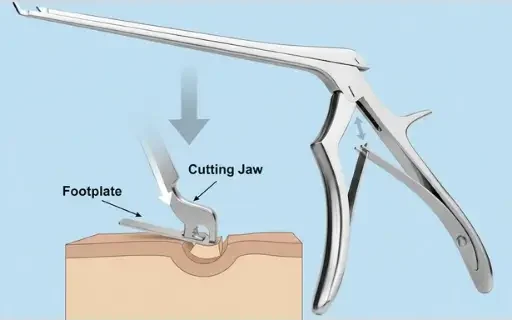
Unlike standard forceps, the Kerrison utilizes a sliding mechanism where the footplate (the thin bottom lip) slips under the bone, and the top cutting edge comes down to “punch out” a clean bite.
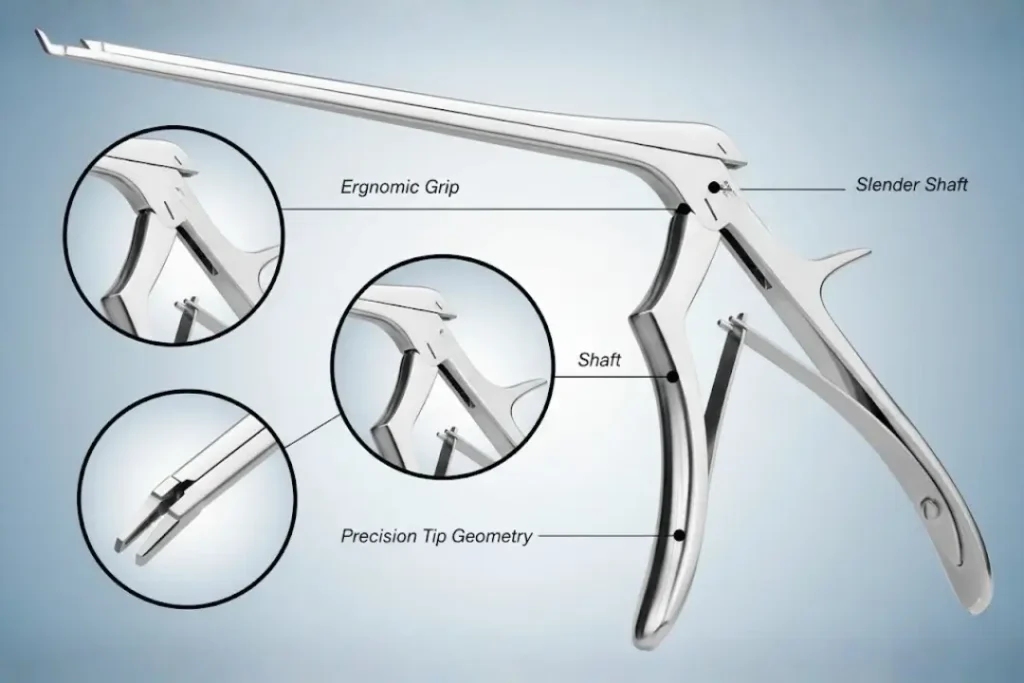
Looking at the product specifications this instrument stands out for several reasons:
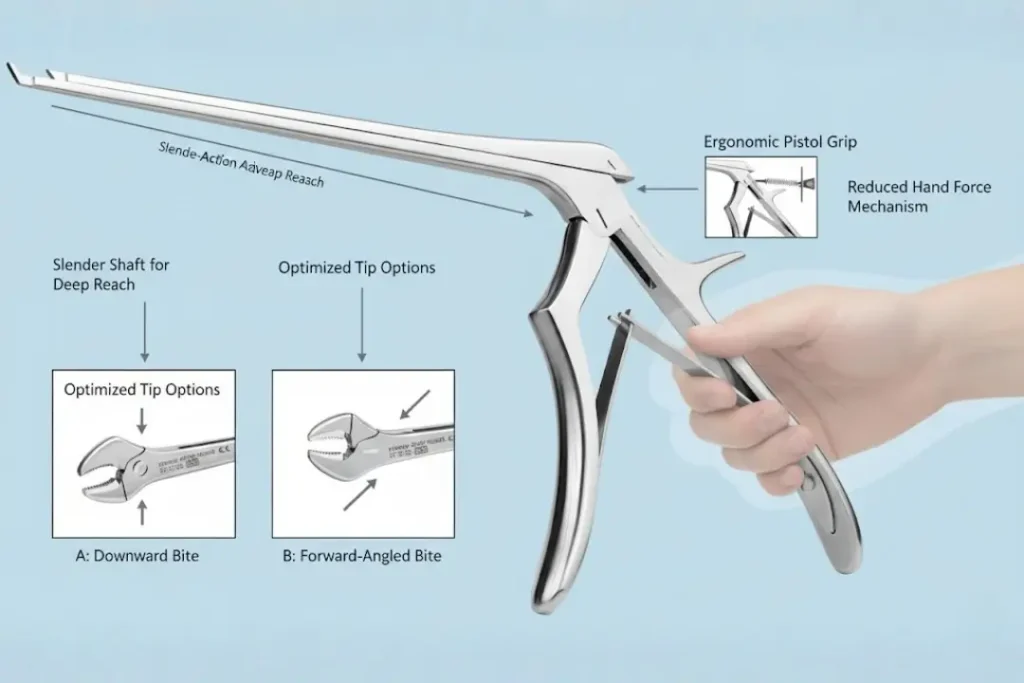
The handle is designed to sit comfortably in the palm, utilizing a spring mechanism. This can reduce the hand fatigue of long procedures where repetitive bone removal is mandatory.
This design provides a greater mechanical advantage, the surgeon cuts through denser bone with less force by using this product.
As shown in the diagram, the tip availability varies. The sensitive angle is the “bite” angle. The upward-biting design allows surgeons to remove bone from beneath a surface (like the lamina or nasal wall) without damaging the delicate soft tissues above it.
The long, thin shaft ensures deep reach into the nasal cavity or spinal canal without obstructing the surgeon’s line of sight.
While often associated with spinal surgery, the Ferris-Smith-Kerrison is listed under our Rhinology category for good reason. Its versatility spans several disciplines:
Rhinology (ENT): It is critical for removing the thick bone of the frontal process of the maxilla during endoscopic DCR procedures. It allows for the creation of a precise osteotomy (bone window) to drain the lacrimal sac.
Neurosurgery / Orthopedics: Known as a “Laminectomy Punch,” it is used to remove the lamina of the vertebrae to relieve pressure on the spinal cord.
Maxillofacial Surgery: Useful for contouring bony irregularities in facial trauma or reconstruction.
When purchasing a Ferris-Smith-Kerrison, the quality of the steel is paramount. A dull rongeur does not cut; it crushes. This can lead to bone splintering and delayed healing.
At 4Tech Bro, our instruments are crafted from premium surgical-grade stainless steel, ensuring:
The Ferris-Smith-Kerrison is more than just a tool; it is an enabler of minimally invasive techniques that improve patient outcomes. Its ability to provide clean, upward cuts in tight spaces makes it irreplaceable in the Rhinology and Neurosurgery instrument tray.
Looking to upgrade your surgical inventory?
Browse our full collection of Rhinology instruments and ensure your OR is equipped with the best.
While both instruments are designed for removing bone, the Ferris-Smith-Kerrison typically features a modified, heavy-duty design. It often incorporates an ergonomic pistol-grip or ring-handle mechanism that provides greater leverage. This allows surgeons to cut through thicker or denser bone with less hand force compared to standard, lighter rongeurs.
In Rhinology, it is frequently used in Dacryocystorhinostomy (DCR) to remove the lacrimal bone and in Ethmoidectomy procedures. In Spinal Surgery (Neurosurgery), it is the primary tool for Laminectomies and Decompression surgeries, used to remove the vertebral lamina and ligamentum flavum to relieve pressure on the spinal cord.
Starting mid-thought, these tools follow a different path - shaped edges and ultra-fine points do the work when precision matters most. Their design avoids harm by cutting cleanly, tailored exactly where it counts.
The tip variations usually refer to the bite width and the footplate thickness.
Smaller sizes (1mm - 2mm) are used for delicate work in tight spaces, such as pediatric cases or cervical spine surgery.
Larger sizes (3mm - 5mm)are used for bulky bone removal in the lumbar spine or larger nasal cavities.
The "up-biting" angle (typically 40° or 90°) ensures the cutting action moves away from the dura or critical soft tissue.
Because the Ferris-Smith-Kerrison has a sliding shaft mechanism, bio-burden (bone and tissue) can get trapped between the rails.
It is critical to use an enzymatic cleaner and flush the shaft thoroughly. If the model is detachable, it must be disassembled prior to cleaning.
It is fully autoclavable. Ensure the instrument is sterilized in the "open" position (or disassembled) to allow steam to reach all surfaces.
Yes. High-quality stainless steel instruments like those from 4Tech Bro are designed to be re-sharpened. However, rongeur's specialized process is sharpening. Improper sharpening can misalign the footplate and the cutting block which can cause the instrument apart the tissue rather than cut it. We recommended professional repair service specialized in surgical rongeurs.
The standard Ferris-Smith-Kerrison design is generally ambidextrous regarding the grip, though the pistol-grip style is contoured. However, the biting mechanism is vertical (up-biting), meaning it functions effectively regardless of which hand is driving the instrument.
S.I.E Sialkot 51310 Pakistan
© 2025 4Tech Bro. Manufacturer & Exporter of Surgical, Dental, Plastic Surgery, Beauty and etc Instruments. All rights reserved.