
Precision in Every Instrument — Excellence in Every Field
The dental clinic tools you use dictate the quality of your work. Dentistry is an incredibly precise medical field. Dentists operate in a highly restricted, sensitive space where saliva, blood, and constant movement make every procedure challenging.
Whether a dentist is performing a complex root canal, extracting an impacted wisdom tooth, or simply doing a routine scaling, there is absolutely no room for equipment failure. A slipped grip or a blunt edge doesn’t just slow down the procedure; it directly impacts patient safety and comfort. That is exactly why clinics around the world are shifting their focus toward sourcing directly from a premium dental instruments manufacturer rather than relying on cheap, mass-produced alternatives.
We have been in the medical manufacturing and export industry for years, and we frequently see clinics trying to cut costs by purchasing low-grade dental instruments. On paper, it looks like a smart financial move. In reality, it is a massive drain on resources.
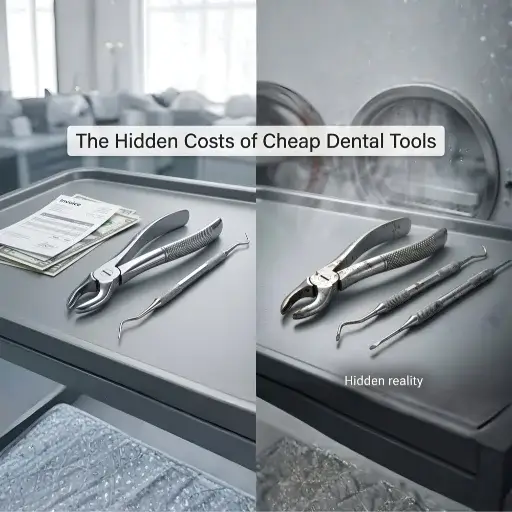
Low-quality dental tools fail fast. The primary enemy of any dental instrument is the sterilization process. After every single use, these tools are scrubbed with harsh chemicals and placed inside an autoclave, where they are blasted with high-pressure steam at extreme temperatures.
Cheap stainless steel cannot handle this cycle. Within a few weeks, these standard tools start to show signs of micro-pitting, which is essentially early-stage rust. The hinges on extraction forceps become stiff, and the sharp edges on scalers and curettes become dull. When a dentist is forced to use a dull tool, they have to apply more physical pressure. More pressure leads to hand fatigue for the dentist and unnecessary trauma for the patient.
It is not just a marketing word; it comes down to the actual engineering and forging process on the factory floor. Here is what a true premium dental instruments manufacturer focuses on:
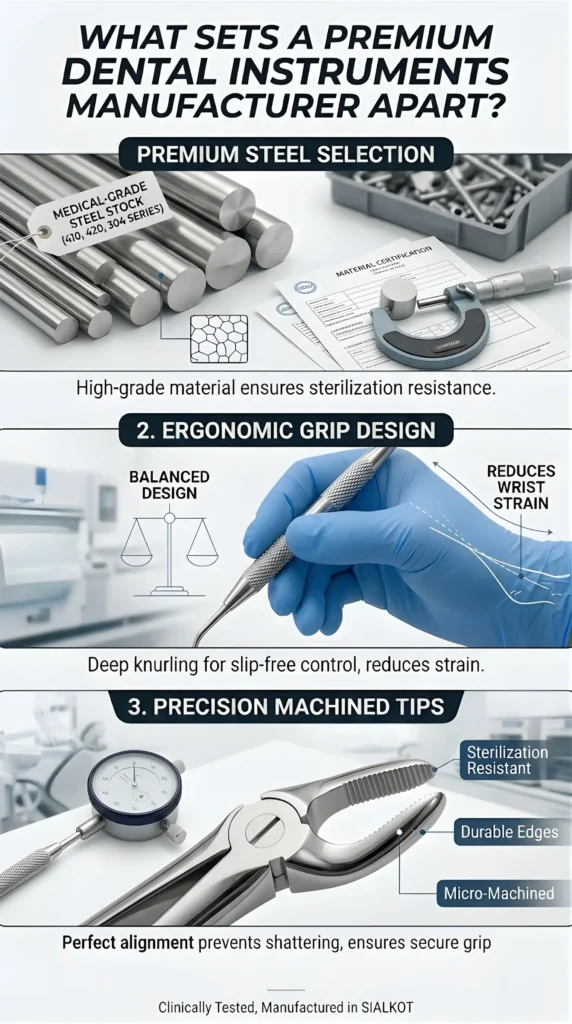
You cannot make a great tool out of bad steel. Premium manufacturers exclusively use specific series of medical-grade stainless steel (like 410 or 420 series for cutting tools, and 304 for non-cutting tools). This ensures high tensile strength and maximum resistance to corrosion during autoclave sterilization.
A dentist might hold a tool for eight hours a day. If the handle is too heavy, too smooth, or poorly balanced, it causes severe wrist strain. High-quality instruments feature deep, precisely milled knurling (the textured pattern on the handle) to ensure a slip-free grip, even when wearing wet surgical gloves.
Look closely at the beak of a premium extraction forceps. The inner serrations are machined to interlock perfectly. This ensures that when the dentist grips a tooth, the instrument bites down securely without slipping or shattering the crown.
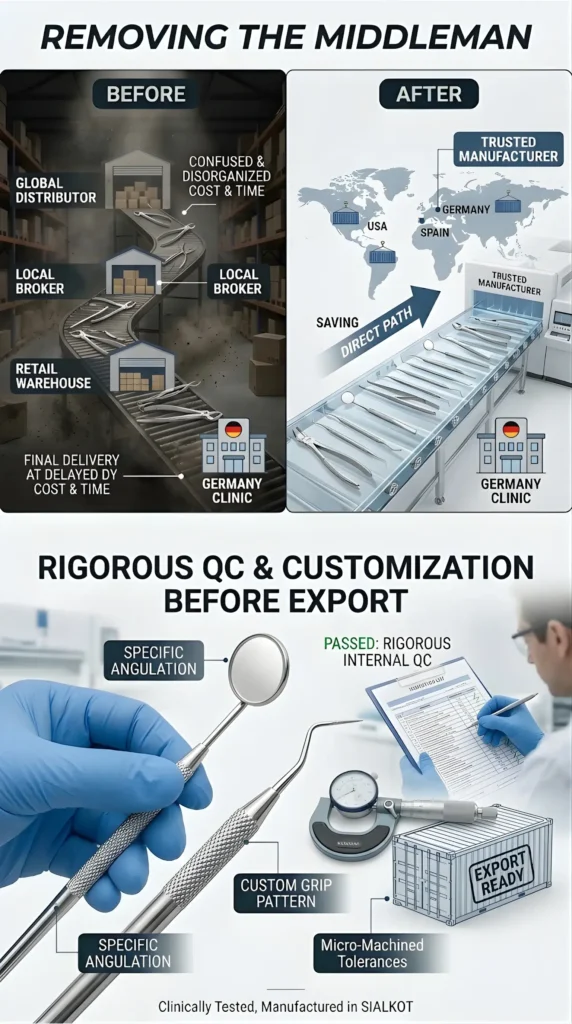
The global demand for reliable dental tools is massive. Clinics in highly regulated markets like Germany, the USA, and Spain are incredibly strict about the quality of the tools they use. For these healthcare providers, sourcing directly from a trusted manufacturer makes the most sense.
Why? Because it completely removes the middleman. When you buy from an established manufacturer, you are getting tools that have passed rigorous internal quality control checks before they are even packed for export. Furthermore, direct manufacturing allows for customization. If a clinic needs a specific angulation on a dental mirror or a custom grip on their periodontal tools, a real manufacturer can adjust the tooling to meet those exact needs.
While a dental setup requires hundreds of different items, there are a few core instruments where quality simply cannot be compromised:
Extraction Forceps and Elevators: These need to withstand heavy torque without bending.
Periodontal Probes and Explorers: The tips must be fine enough to detect the smallest cavities but strong enough not to snap.
Scalers and Curettes: They must hold a sharp edge for a long time to easily remove hard plaque without damaging the tooth enamel.
Your patients trust you with their oral health, and you need to be able to trust your tools. Buying dental instruments is not just a recurring clinic expense; it is a direct investment in the efficiency of your practice and the comfort of your patients. By partnering with a premium dental instruments manufacturer, you guarantee that your clinic is equipped with tools that are safe, reliable, and built to survive the daily grind of modern dentistry.
You can often tell by the finish and the documentation. True medical-grade tools have a uniform finish (often matte or satin to reduce glare from dental lights) and the manufacturer will easily provide material certifications proving the exact grade of stainless steel used.
Standard instruments often lack the proper carbon-to-chromium ratio in their steel, and they may not have gone through a proper "passivation" process. Passivation is a chemical treatment used by top manufacturers that creates a microscopic protective shield against rust.
Absolutely. An instrument that is too heavy causes hand fatigue and tremors over a long shift. Premium manufacturers use hollow handles for thicker instruments (like standard scalers) to keep them lightweight while maintaining a thick, comfortable grip.
Yes. One of the biggest advantages of working directly with a manufacturer instead of a retail supplier is the ability to request modifications, custom handle grips, or specific tip angulations for bulk orders.
S.I.E Sialkot 51310 Pakistan
© 2025 4Tech Bro. Manufacturer & Exporter of Surgical, Dental, Plastic Surgery, Beauty and etc Instruments. All rights reserved.