
Precision in Every Instrument — Excellence in Every Field
At 4TECH BRO, we understand that surgical scissors are not just tools; they are extensions of the surgeon’s hands. We are spotlighting our premium range of cardiovascular and neurosurgery scissors, and it is designed for deep access, delicate tissue handling, and absolute precision. The success of a procedure and a complication often come down to two things: firstly, the surgeon’s skill and secondly, the quality of their instruments.
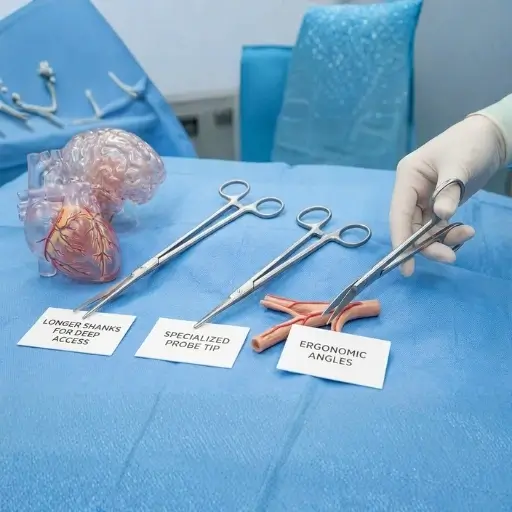
Standard surgical scissors cannot navigate the anatomy involved in brain and heart surgeries. Procedures requiring deep access into the cranial cavity or thoracic cavity demand instruments with specific characteristics:
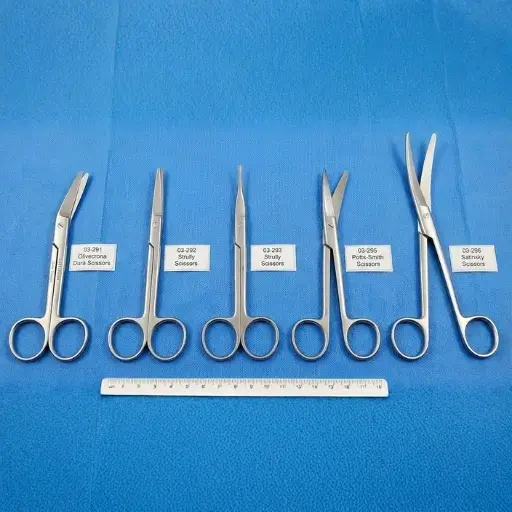
This is designed specifically for neurosurgery. The surgeons used angled blades to cut the dura mater effectively without damaging the delicate brain tissue. Ergonomic rings and a sturdy build ensures that it controls the most critical parts of a craniotomy.
Strully scissors are a staple in the procedures of neurological, it is known for their versatility in deep-tissue dissection. We offer two distinct variations to suit the procedure’s needs. This safety feature allows the surgeon to push tissue aside or explore dissection planes without accidentally piercing vessels or nerves. Both models come in a 220 mm length, providing the necessary reach for deep operative fields.
These scissors are widely used in cardiovascular surgery. It typically features angled blades (as seen in the profile) perfect for extending arteriotomy (incisions in blood vessels) or opening ducts. At 190 mm, they conduct a balance of reach or fine control for vascular reconstruction.
With a length of 245 mm, the Satinsky is one of the longest instruments in this set. The subtle S-curve, or curved shank, allows for unique access angles, often required when working around the aorta or other major structures in the chest cavity where a straight scissor cannot reach.
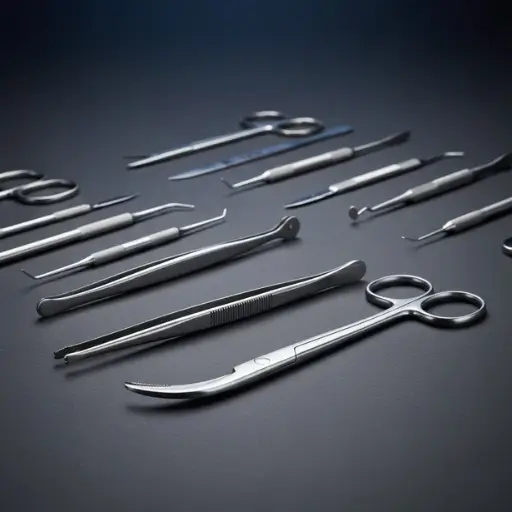
Choosing the right tip is a critical decision during dissection. We offer distinct variations for different phases of surgery.
Stille scissors feature a bulbous or “probe” tip on the lower blade. Neurosurgery allows the surgeon to slide the instrument along a dissection plane (such as a nerve sheath or vessel wall) without fear of piercing it. It is the standard for “blind” dissection where visibility is compromised.
Strully Pointed scissors have the function of double sharp tips. Surgical applications are used for sharp dissection of tough fibrous tissue or precise arteriotomy (incising a blood vessel) where a clean, immediate entry is required.
These scissors are widely used in:
The precise cutting capabilities makes them essential tools for life-saving in surgical interventions
Cardiovascular and neurosurgery scissors are indispensable instruments in the modern surgical field. These instruments have precision design, superior materials, and specialized functions which make them essential for handling the most difficult and delicate surgical procedures. Choosing professionally manufactured scissors that maintains accuracy, reliability, and optimal surgical performance in most of the operations, primarily in cardiovascular and neurological operations.
True, if cleaning follows medical rules, tools stay sterile, care stays consistent, yet function never drops, risk stays low.
Needle-thin edges define cardiovascular scissors, built to move with accuracy through tight areas inside blood vessels. Their slim form allows careful navigation where space is extremely limited. Sharp tips help reach deep structures without causing unnecessary disruption. Precision comes from a design focused on control during intricate tasks. Movement feels smooth even in confined zones around the heart.
Starting mid-thought, these tools follow a different path - shaped edges and ultra-fine points do the work when precision matters most. Their design avoids harm by cutting cleanly, tailored exactly where it counts.
Right after using, wipe down the scissors with a proper cleaning method. Check the edges now and then - they need to stay keen. Slip them into safe storage trays when done. A little care keeps them working well over time. Sharp tools mean steady hands during procedures.
Clean, accurate cuts come easily with these scissors, while surgery time shrinks noticeably. Healing improves because of how safely they work inside the body.
S.I.E Sialkot 51310 Pakistan
© 2025 4Tech Bro. Manufacturer & Exporter of Surgical, Dental, Plastic Surgery, Beauty and etc Instruments. All rights reserved.